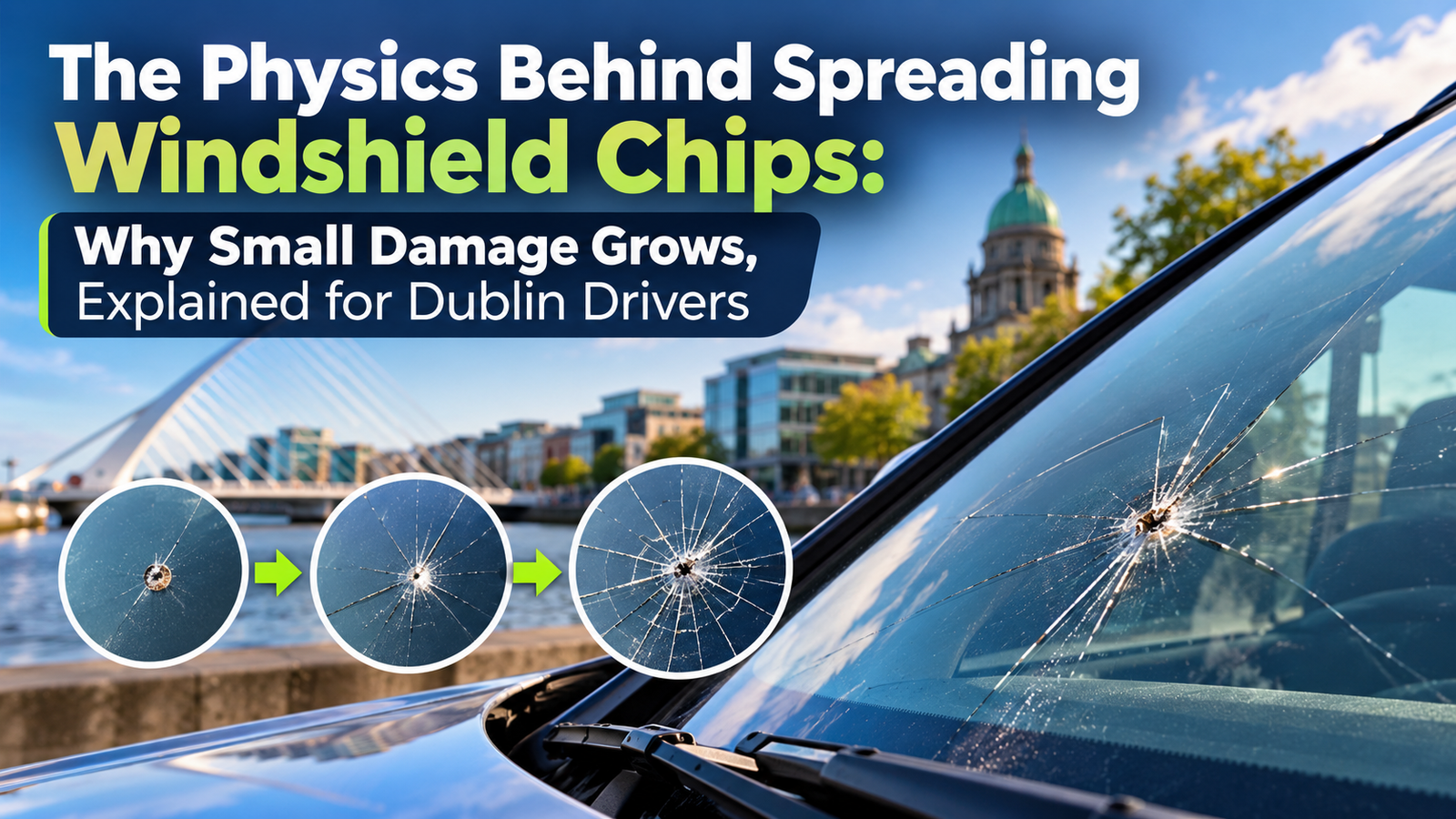
Almost everyone who has driven for a few years has had the experience. A tiny chip appears in the windshield after a stone strike, small enough to ignore. Weeks later, after a cold morning or a hot afternoon or a bumpy road, the chip has sprouted a crack that crawls across the glass. It seems almost mysterious, as if the damage had a mind of its own. In fact, the behavior follows well understood principles of materials science. Glass is strong in some ways and surprisingly fragile in others, and a chip is exactly the kind of flaw that exposes the weakness.
This article explains why Windshield Chip Spread Issue Dublin spread, in language that does not require an engineering background. It covers how glass fails, how stress concentrates at flaws, what temperature, vibration, moisture, and structure contribute, and how laminated construction changes the picture. It then considers the conditions around Dublin, California, in the Tri-Valley area of Alameda County, where commuting, climate, and traffic create a specific mix of stresses. The aim is to make the process understandable rather than to advise on any particular vehicle.
Glass Is Strong Until It Is Not
Glass is a rigid, brittle material. It does not bend and yield the way metal does. Under load it stores elastic energy until a flaw gives way, and then the failure runs quickly. This brittleness is the key to understanding crack growth.
In theory, the strength of glass is very high, because the chemical bonds between atoms are strong. In practice, real glass is much weaker, because its surface carries microscopic flaws from manufacturing, handling, and wear. Strength tests show that the weakest flaw, not the average surface, determines when glass breaks. A pristine windshield tolerates considerable stress. A windshield with a chip has a major flaw that dramatically lowers the stress at which failure can begin.
Stress Concentration at a Flaw
The central concept is stress concentration. When a force is applied to a piece of material, the stress is distributed through it. If there is a crack or notch, the lines of force bunch up around its tip, producing stress far higher than the average across the part.
A helpful comparison is a sheet of paper. A smooth sheet is hard to tear. Nick the edge with scissors, and a gentle pull continues the tear easily. The nick does not weaken the paper overall. It focuses the stress at one point.
A chip in a windshield acts as that nick. The impact has produced a cone of crushed glass and often tiny legs, or cracks, radiating outward. At the tip of each leg, stress is intensified. Ordinary daily forces that glass would otherwise shrug off can now drive those tips forward.
What Happens at the Moment of a Strike
When a stone hits a windshield at speed, the sequence is rapid.
- The stone’s kinetic energy is transferred into a small area of the outer glass.
- The surface is crushed, and a cone shaped fracture forms, widening into the glass, a pattern known as a Hertzian cone.
- Small cracks, called legs, may radiate from the point of impact.
- Fragments may be ejected, leaving a pit or crater.
- The inner glass layer and the plastic interlayer usually remain intact, which is why the windshield does not shatter.
The result is a damaged zone that is small in size but contains many microscopic crack tips, each a potential starting point for further growth.
The Forces That Make Chips Grow
Several forces act on a windshield, and any of them can push a crack tip forward.
Thermal Stress
Glass expands when heated and contracts when cooled, but it does not do so evenly if one part is hotter than another. A windshield sitting in the sun may have a hot center and a cooler edge shaded by the frame. Turning on cold air conditioning, or defrosting a frozen windshield with hot air, creates sharp temperature gradients. These gradients produce internal stress, and a flaw focuses it.
In regions with large day to night swings, glass cycles through expansion and contraction daily. A chip can respond by creeping, extending a fraction at a time with each cycle.
Mechanical Flexing
A car body is not perfectly rigid. It twists slightly over bumps, through turns, and when a door is slammed. The windshield, being bonded to the frame, flexes with it. For intact glass the movement is trivial, but at a chip, repeated flexing works the crack tips like bending a paperclip.
Vibration
Road vibration and engine vibration transmit continuous small stresses to the glass. Over days and weeks of driving, the repeated loading contributes to fatigue at the flaw.
Pressure Changes
Slamming a door in a closed car raises cabin air pressure briefly, pushing outward on the glass. Altitude and wind pressure at highway speed also load the windshield. These pressure pulses can be the final trigger for an extension.
Moisture and Chemistry
Water is more than an inconvenience. In glass, water can chemically react at the tip of a crack, weakening the bonds there in a phenomenon called stress corrosion or subcritical crack growth. This means a crack can advance slowly even under loads that would not break fresh glass. Moisture also carries dirt into the break, and the contamination makes later repair more difficult.
Freezing
Water inside a chip that freezes expands, wedging the crack open. A cycle of freezing and thawing repeats the effect.
Slow Growth and Sudden Growth
Crack growth in glass has two modes. In the first, subcritical growth, the crack advances very slowly under sustained stress and moisture. It may be invisible to the eye from day to day. In the second, rapid growth, a threshold is crossed, and the crack runs quickly, sometimes in an instant, and extends several inches.
That is why a chip that appears stable for weeks can seem to crack overnight. The slow growth built up toward a critical state, and then a trigger like a cold wash or a bump delivered the last bit of stress.
The Laminated Structure Under Stress
Windshields are laminated, with two layers of glass and an interlayer of plastic. That structure alters how damage develops.
Outer layer damage. The outer ply takes the impact. When a chip is limited to this layer, the inner ply and interlayer hold the assembly together.
Interlayer role. The plastic layer absorbs energy and holds fragments, so cracks in one ply tend not to automatically pass through to the other. Even so, a crack in the outer ply can eventually lead to cracking of the inner ply.
Different stress states. The outer ply is in a different thermal and mechanical environment from the inner ply, which is warmed by the cabin. This difference can drive stress in the chipped outer ply.
The laminate is why a windshield can be repaired at all, because the outer ply can be filled with resin without taking the whole structure apart.
Where Chips Are More Likely to Spread
Certain conditions raise the chance of spread.
Near the edge. The edge of a windshield is a high stress region. The glass is bonded to the frame, and edge flaws combine with bonding stress. A chip within a few inches of the edge often spreads sooner.
In the driver’s side area. Not by physics alone, but because this region is subject to the same thermal gradients as the rest.
Large chips with long legs. Longer legs mean larger starting cracks.
Chips with trapped moisture. Stress corrosion proceeds at an accelerated rate.
Chips on older glass. Glass with existing wear has more flaws to interact with the damage.
Chips on vehicles under frequent flexing. Vehicles that carry heavy loads or travel rough roads put added stress on the glass.
What Repair Does to Crack Growth
Resin repair works against the mechanisms above. A clear resin is injected into the break under vacuum and pressure, filling the cone and the legs, displacing air and moisture. Ultraviolet light cures it into a hard, glass like plastic.
Repair addresses several of the drivers of growth.
- It fills the void, so the crack tips are supported rather than free.
- It seals out water, stopping stress corrosion and freezing.
- It transfers load across the break, reducing stress concentration.
- It restores some of the original strength.
It is not a perfect return to original, but studies and industry experience show that repaired chips are far less likely to spread than untreated ones. Timing matters, because clean, dry damage fills better.
Dublin Conditions and Their Effect on Chips
The environment around Dublin adds particular stresses.
Hot inland summers. Tri-Valley summer days can be warm to hot, with a vehicle’s interior reaching much higher temperatures when parked in the sun. When a driver turns on the air conditioning, the interior face of the windshield cools quickly while the exterior remains hot, creating a gradient.
Large daily temperature range. Cooler evenings and mornings follow warm days, so glass goes through repeated cycles.
Winter mornings. Cold mornings and occasional frost lead to defrosting, which introduces another gradient. Using warm, not hot, air gradually helps limit shock.
Heavy commuting on Interstate 580 and 680. High speed traffic, truck traffic, and construction produce more strikes and more vibration exposure.
Construction dust and gravel. Active development in and around Dublin sends aggregate and debris onto the road.
Wind. Valley winds can carry grit, adding pitting and surface wear.
Rough pavement and potholes. Flexing from road irregularities adds to mechanical stress.
Everyday Habits That Influence Spread
Understanding the mechanisms points toward some simple, general habits.
- Cover a fresh chip with clear tape. This helps keep out moisture and dirt before it is evaluated.
- Park in shade or use a sunshade where feasible. This reduces the heat load.
- Let the cabin temperature change gradually. Avoid pointing the strongest cold air at a hot windshield or the hottest defrost at a frozen one.
- Close doors gently. Avoiding slamming, especially with windows up, lessens pressure pulses.
- Avoid hot water on cold glass. Rapid temperature change is a classic trigger.
- Skip high pressure washing near the chip. Water driven into the damage may complicate repair.
- Take note of the chip’s size. A photo with a coin for scale makes growth easy to track.
Common Misunderstandings
“If it has not spread yet, it won’t.” Subcritical growth can hide and then suddenly accelerate.
“Spreading is caused by a second impact.” Often no new impact occurs. Temperature, flexing, and pressure are enough.
“Only big chips spread.” Even small chips can have legs and sharp crack tips.
“Tape fixes it.” Tape only protects temporarily. It does not stabilize the crack.
“Cracks only grow in winter.” Heat gradients cause as much growth as cold.
“A repaired chip can never spread.” Repair greatly reduces the likelihood, but success depends on the quality of the fill and the original damage.
Frequently Asked Questions
Why do windshield chips spread?
Because a chip concentrates stress at its crack tips, and ordinary forces like temperature changes, vibration, flexing, and pressure pulses can push those cracks forward.
How quickly can a chip spread?
It varies. Some stay stable for months, while others extend within days, especially after a sudden temperature change or a hard bump.
Does hot weather make chips spread?
Heat itself is not the main problem, but gradients are. Cooling a hot windshield rapidly can create enough stress to extend a crack.
Does cold weather make chips spread?
Yes. Cold increases brittleness, and freezing water inside a chip can wedge it open. Defrosting with very hot air adds a gradient.
Can driving on bumpy roads make a chip worse?
It can. Flexing and vibration contribute to fatigue at the damaged site.
Does moisture in a chip matter?
Yes. Water promotes slow crack growth through stress corrosion and makes repair more difficult by carrying contaminants into the break.
Why do cracks often start from a chip?
The chip is a pre existing flaw. Cracks form by extending from such flaws, not from undamaged glass.
Is a spreading crack a safety concern?
It can be. A long crack reduces visibility, weakens the windshield’s structural contribution, and may become a legal concern depending on location and rules.
Does a bigger windshield spread cracks more easily?
Larger and more steeply raked windshields have more area exposed to heat and flexing, which can matter, though flaw characteristics remain the main factor.
Final Thoughts
Chips spread because glass is brittle, flaws concentrate stress, and the everyday environment of a car provides a steady supply of forces. Heat, cold, vibration, flexing, pressure, and moisture each contribute a little, and a chip gives them a place to work. Seen this way, the behavior of damaged glass is predictable rather than mysterious.
For readers curious about why windshield chips spread in Dublin, the physical story explains it well. The Tri-Valley’s heat, temperature swings, and heavy highway use give small flaws plenty of opportunity to grow, and recognizing the mechanisms helps make sense of what happens to glass between the first strike and the first crack.